What if the spring itself could be made from natural materials?
Coir fibre, bonded with natural latex and shaped into spring elements. An inventive approach already used in a baby mattress—and the starting point for something bigger.
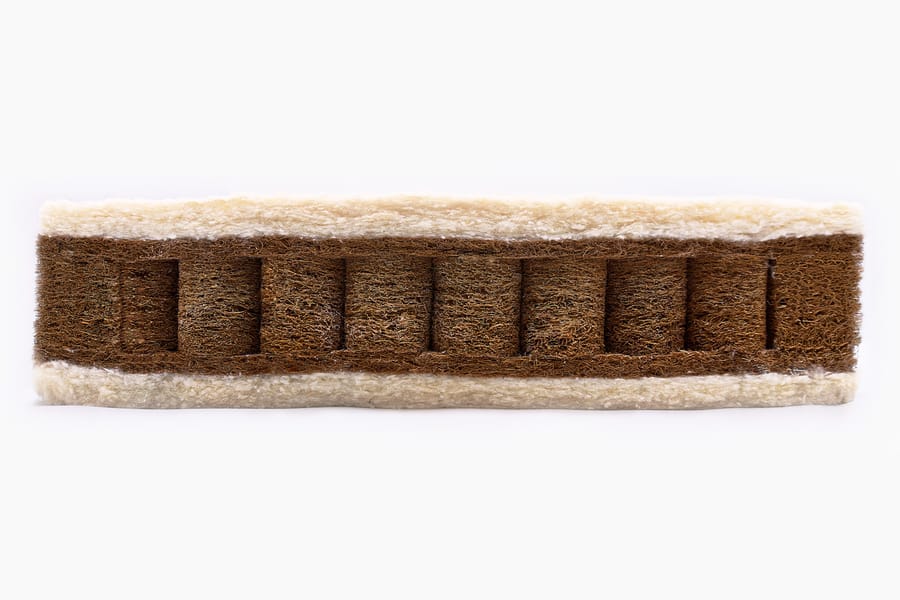
A baby mattress construction showing coir spring elements and a wool layer. Product image from The Cot Mattress Company.
COCONUT FIBRENATURAL LATEXA NEW DIRECTION TO EXPLORE
The idea beneath the cover
Natural materials. With a spring in their step.
Coir is the tough fibre from a coconut’s outer husk. Here, it is bonded with natural latex and formed into individual spring elements, rather than used only as a flat sheet around a metal spring unit.
The elements sit within a supporting coir frame. In the existing baby mattress construction, a wool layer completes the natural core arrangement.
Natural Sprung is an early-stage project exploring where this approach could go next: from baby mattresses to an adult collection.
Different sizes and sleepers need different designs. An adult version would need its own development and testing; the baby mattress construction is a starting point, not proof of adult performance.
For little sleepers
A small mattress. A considered construction.
The natural spring approach is already used in The Excellence baby mattress. Its complete specification, fit, cover system and suitability matter together; natural materials alone do not establish a safety advantage.
For grown-up possibilities
The next chapter is taking shape.
Could the same material idea inspire a natural sprung adult mattress? That is the opportunity we want to explore, with comfort, support and durability developed for adult use.
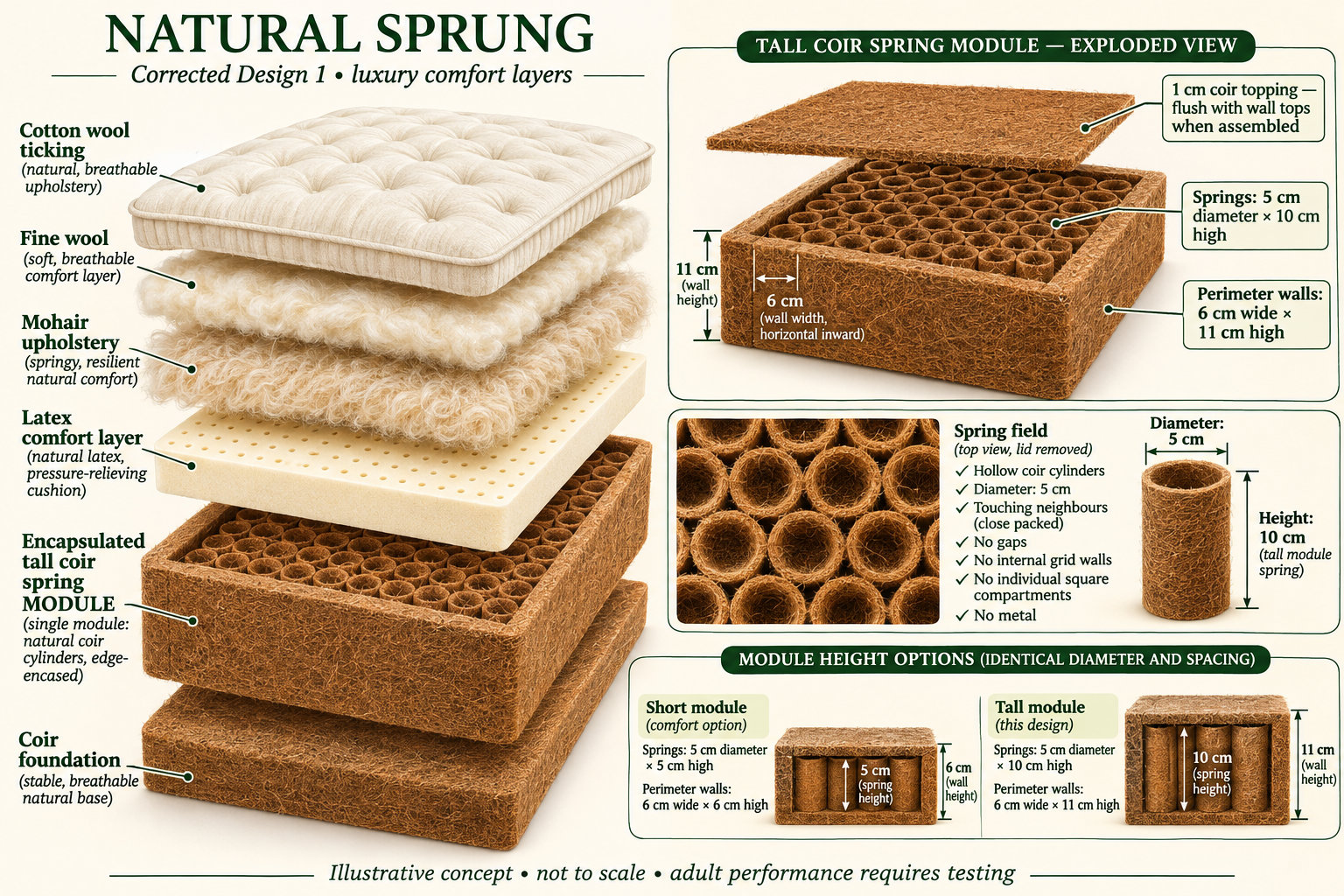
Design 1 — corrected luxury-layer concept
Wool, mohair and latex. An encapsulated spring core.
The original comfort-layer idea, corrected to show the tall spring unit with the same 5 cm spring diameter as the short unit.
Corrected 14 November 2026. Illustrative concept, not to scale or a manufacturing specification. Select the drawing to enlarge it.
Both spring sizes are 5 cm in diameter and sit tightly against neighbouring elements. Only the height changes: 5 cm or 10 cm. Surrounding perimeter walls are 6 cm wide. Each unit has a 1 cm coir topping over the spring field, with its upper surface level with the top of the walls.
The short unit therefore uses 6 cm-high walls; the tall unit uses 11 cm-high walls. Those heights describe the springs plus topping, with any base thickness separate. The topping is intended to flex with the springs. Adult comfort, individual response, stability and durability remain to be established through testing.
The adult design brief remains a single-sided mattress rotated head to foot, with wool, mohair and latex comfort materials above the enclosed spring core. Exact compositions, comfort-layer depths, attachment methods, intended bed base and finished fire performance require development and verification.
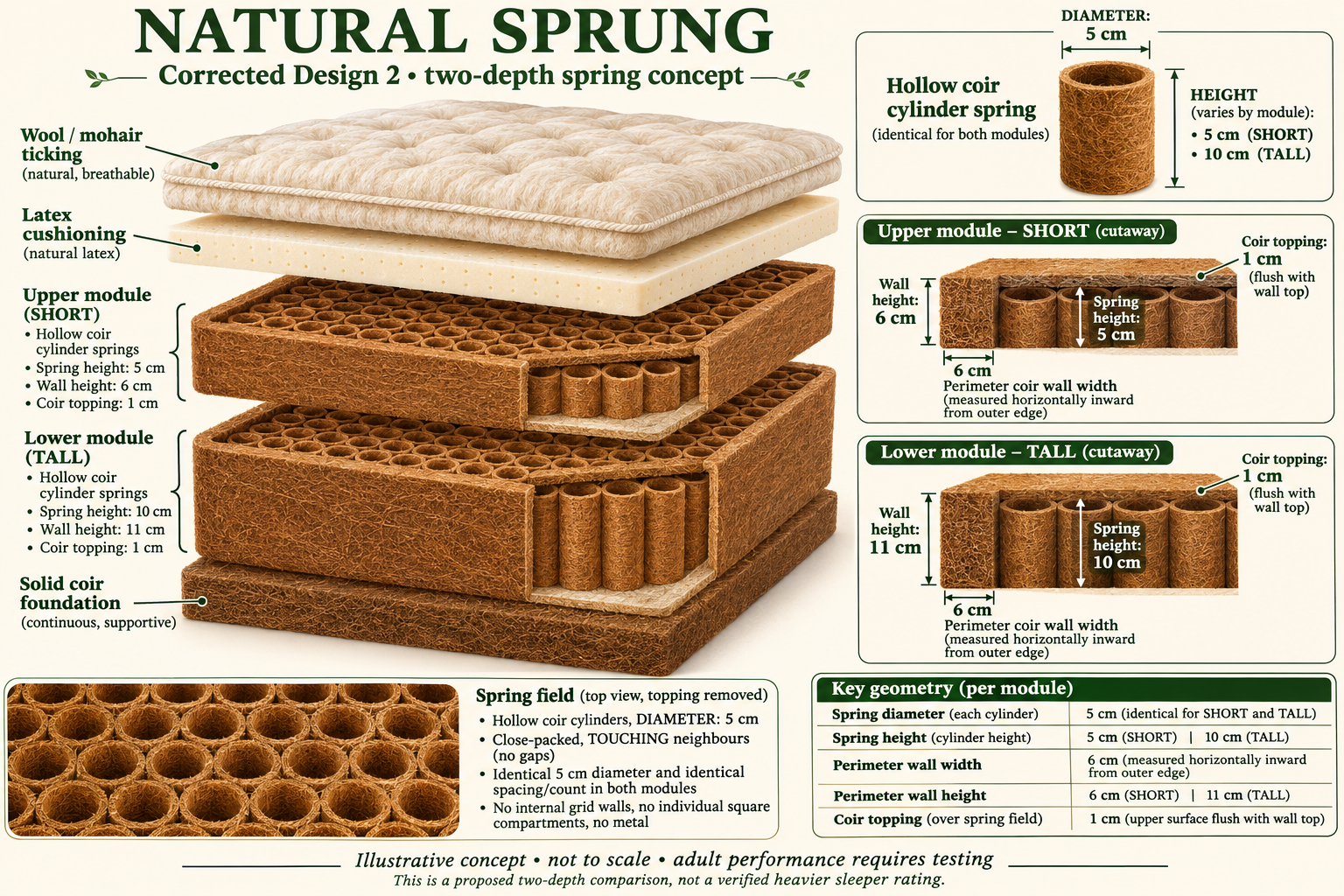
Design 2 — corrected two-depth concept
Two spring depths. The same spring diameter.
A proposed short module above a tall module, with a solid coir foundation. Each module has its own coir topping and perimeter enclosure. This arrangement has no verified weight rating.
Corrected 14 November 2026. Illustrative concept, not to scale or a manufacturing specification. Select the drawing to enlarge it.
Both spring sizes are 5 cm in diameter and sit tightly against neighbouring elements. Only the height changes: 5 cm or 10 cm. Surrounding perimeter walls are 6 cm wide. Each unit has a 1 cm coir topping over the spring field, with its upper surface level with the top of the walls.
The short unit therefore uses 6 cm-high walls; the tall unit uses 11 cm-high walls. Those heights describe the springs plus topping, with any base thickness separate. The topping is intended to flex with the springs. Adult comfort, individual response, stability and durability remain to be established through testing.
The adult design brief remains a single-sided mattress rotated head to foot, with wool, mohair and latex comfort materials above the enclosed spring core. Exact compositions, comfort-layer depths, attachment methods, intended bed base and finished fire performance require development and verification.
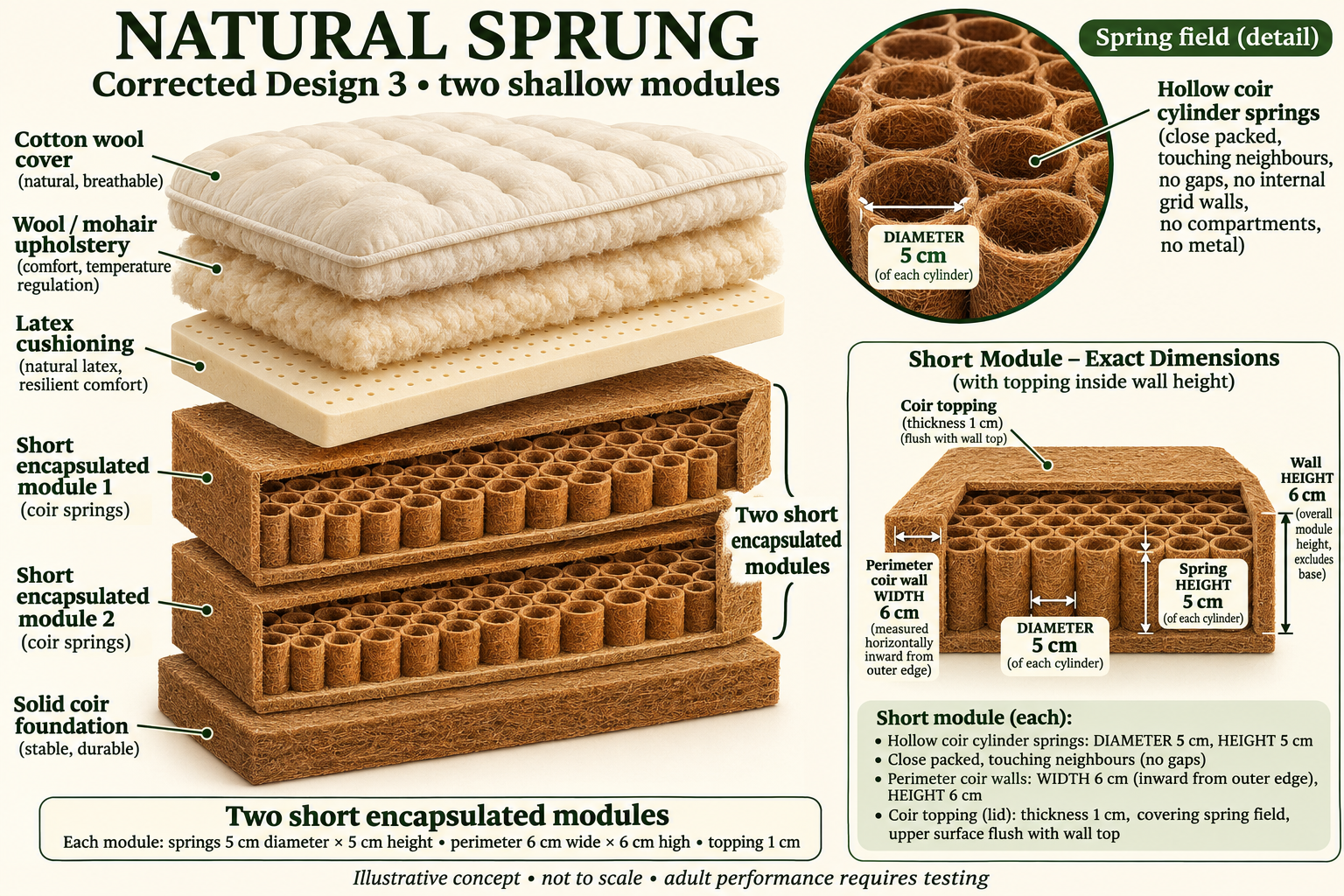
Design 3 — corrected shallow-module concept
Two shallow modules. Each enclosed in coir.
Two short spring modules, each with 5 cm-high springs, 6 cm-high perimeter walls and a 1 cm coir topping. Each module has its own topping; there is no additional separator sheet specified between them.
Corrected 14 November 2026. Illustrative concept, not to scale or a manufacturing specification. Select the drawing to enlarge it.
Both spring sizes are 5 cm in diameter and sit tightly against neighbouring elements. Only the height changes: 5 cm or 10 cm. Surrounding perimeter walls are 6 cm wide. Each unit has a 1 cm coir topping over the spring field, with its upper surface level with the top of the walls.
The short unit therefore uses 6 cm-high walls; the tall unit uses 11 cm-high walls. Those heights describe the springs plus topping, with any base thickness separate. The topping is intended to flex with the springs. Adult comfort, individual response, stability and durability remain to be established through testing.
The adult design brief remains a single-sided mattress rotated head to foot, with wool, mohair and latex comfort materials above the enclosed spring core. Exact compositions, comfort-layer depths, attachment methods, intended bed base and finished fire performance require development and verification.
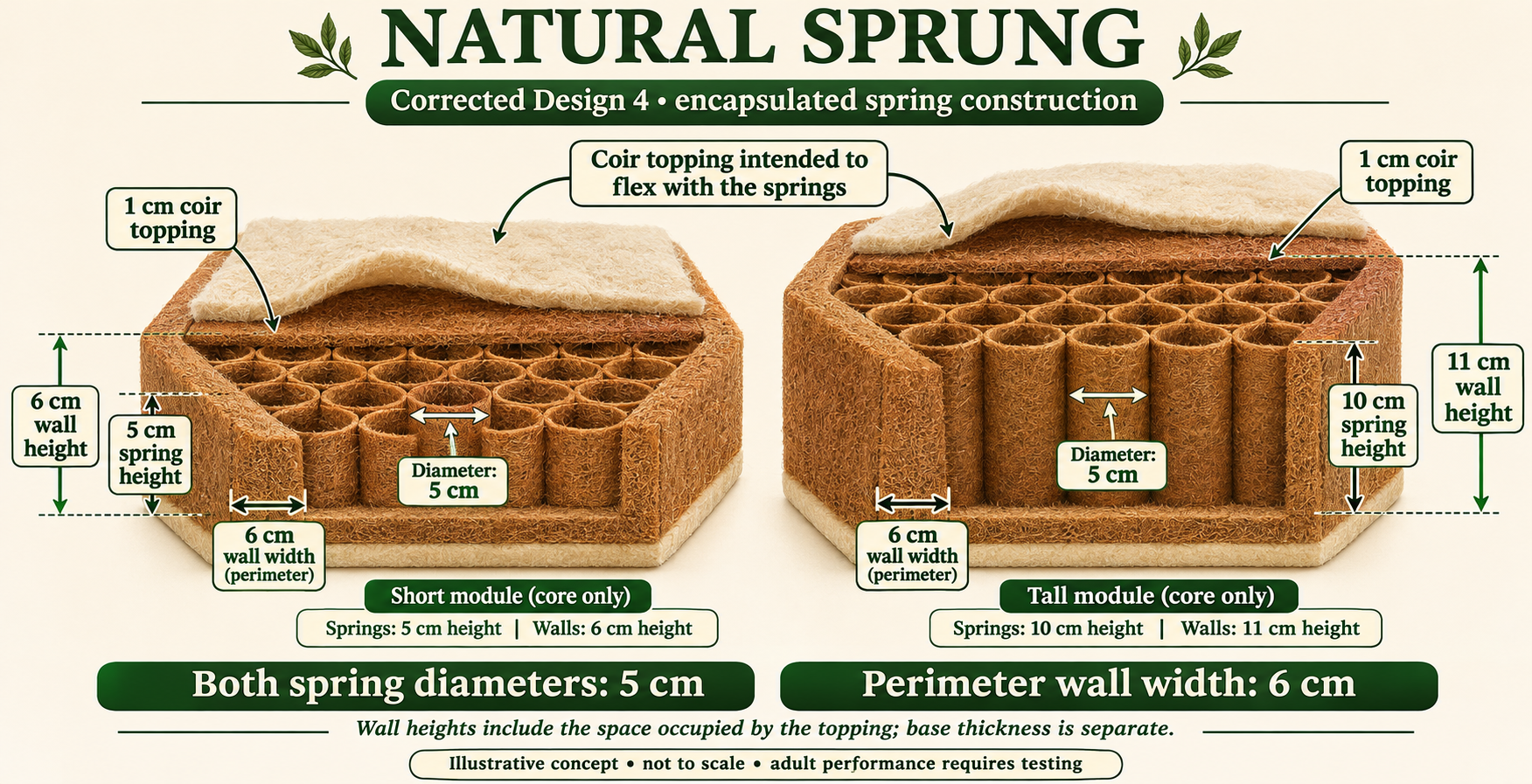
Design 4 — corrected enclosure detail
Close-packed springs. Coir around the outside.
This corrected detail replaces the earlier internal-divider drawing. The springs sit tightly together within wide perimeter coir walls; internal grid walls are not part of the confirmed construction.
Corrected 14 November 2026. Illustrative concept, not to scale or a manufacturing specification. Select the drawing to enlarge it.
Both spring sizes are 5 cm in diameter and sit tightly against neighbouring elements. Only the height changes: 5 cm or 10 cm. Surrounding perimeter walls are 6 cm wide. Each unit has a 1 cm coir topping over the spring field, with its upper surface level with the top of the walls.
The short unit therefore uses 6 cm-high walls; the tall unit uses 11 cm-high walls. Those heights describe the springs plus topping, with any base thickness separate. The topping is intended to flex with the springs. Adult comfort, individual response, stability and durability remain to be established through testing.
The adult design brief remains a single-sided mattress rotated head to foot, with wool, mohair and latex comfort materials above the enclosed spring core. Exact compositions, comfort-layer depths, attachment methods, intended bed base and finished fire performance require development and verification.
A coconut has more to give
From a coconut husk. To the heart of a mattress.
The coconut gets the attention. Its tough, hairy outer husk deserves a little of the limelight too. That is where coir comes from—and where our material story begins.
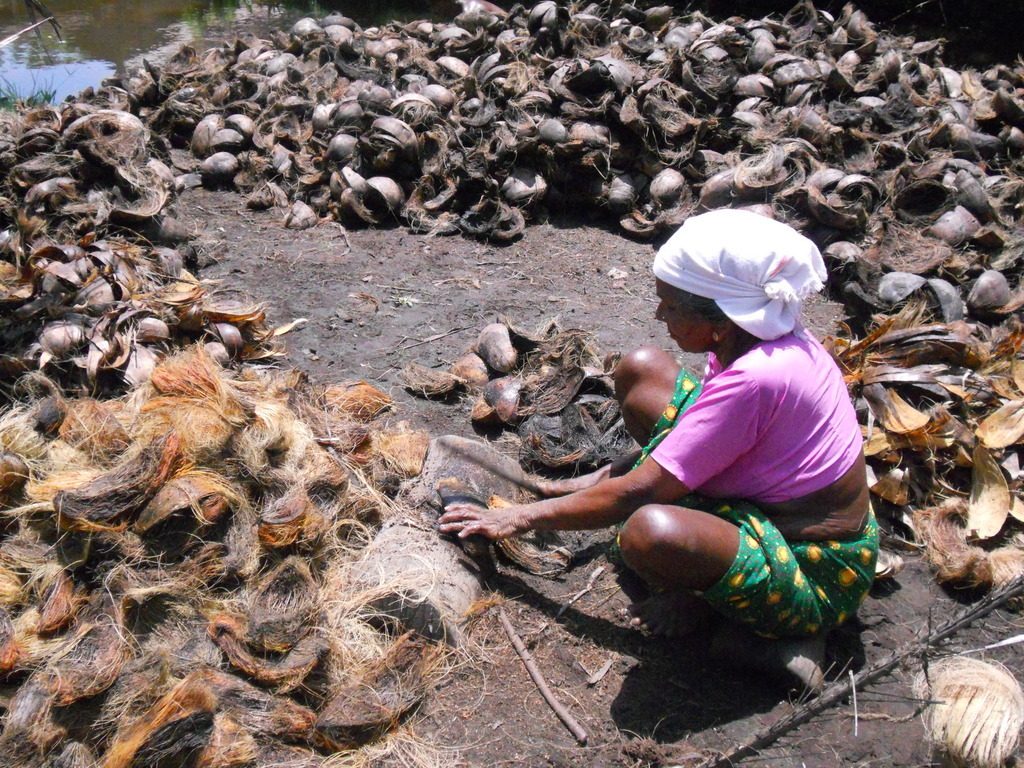
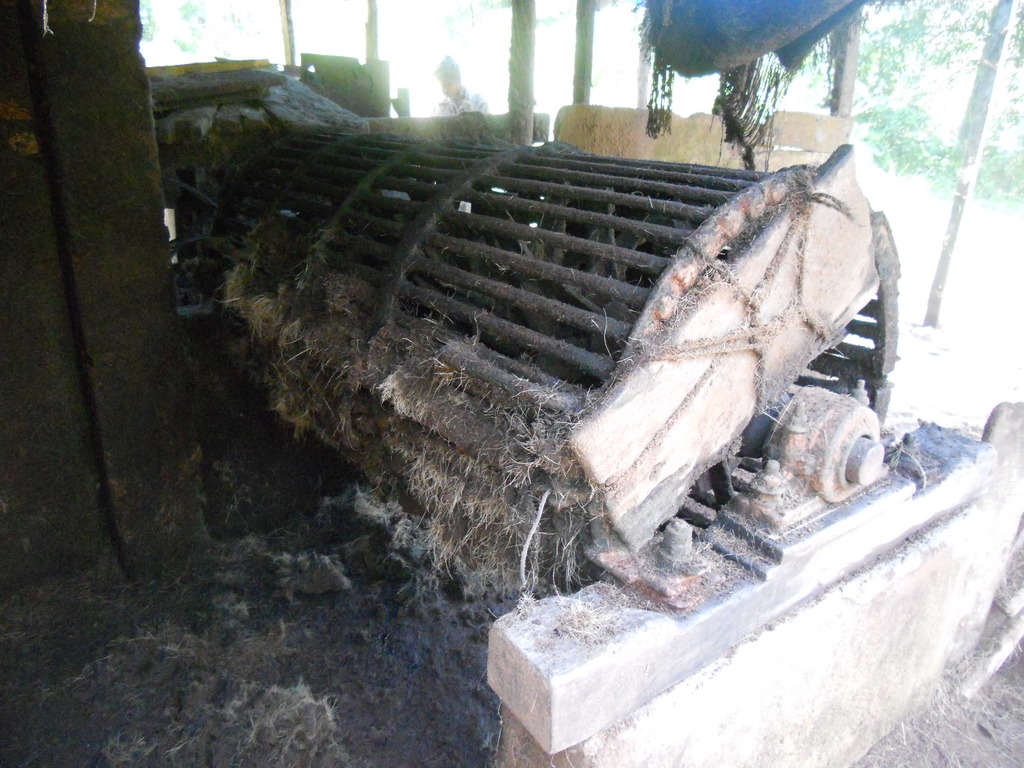
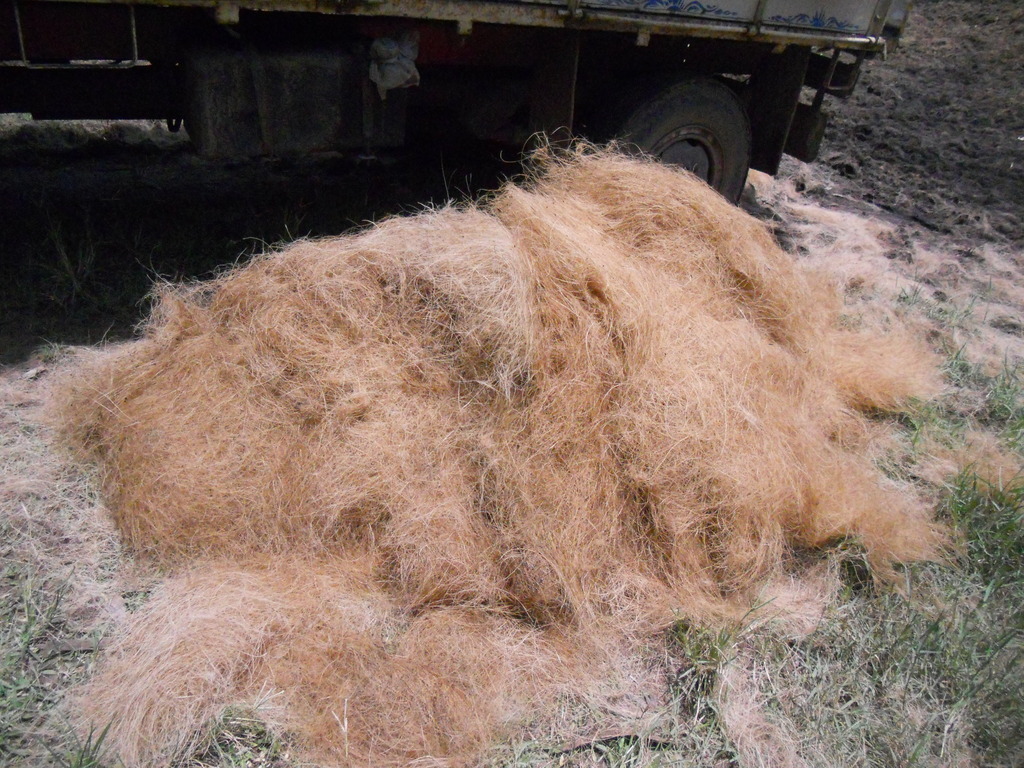
The husk is where it begins.Handling coconut husks: the raw material from which coir fibre is obtained.Photo: Fotokannan / Wikimedia Commons · CC BY-SA 3.0. Original photograph, displayed at reduced size.From husk to useful fibre.A closer look at machinery used in the coir industry.Photo: Fotokannan / Wikimedia Commons · CC BY-SA 3.0. Original photograph, displayed at reduced size.The golden fibre.Separated coir fibres, ready for further processing into useful products.Photo: Fotokannan / Wikimedia Commons · CC BY-SA 3.0. Original photograph, displayed at reduced size.
Coir production in Kerala, India. These documentary photographs illustrate the wider coir industry; they do not identify Natural Sprung’s suppliers or show manufacture of our spring elements. India and Sri Lanka both have established coir industries. Explore how coir is processed ↗
A useful second life for the husk.
Coconuts are grown for food, oil and other products. Recovering fibre from their husks makes use of a by-product of that crop: a material with a job to do, rather than something to overlook.
That is the appeal of coir. Take an existing plant resource, separate out its useful fibres, and turn them into something lasting. We are interested in making good use of what the coconut already gives us.
Renewable by origin.
Coir is a plant-derived, renewable fibre. Coconut palms produce successive crops of fruit, so harvesting the husk does not require felling the palm for each crop.
Renewable describes where the fibre comes from. The environmental story also depends on how it is grown, processed and transported. Those details matter as the Natural Sprung range develops.
Toughness with a purpose.
Brown coir is a coarse, robust fibre with a naturally high lignin content. It has long been put to work in demanding products such as ropes and mats. Its toughness and resilience make it an interesting material to explore inside a mattress.
In our spring construction, coir is bonded with natural latex and formed into individual elements. The fibre provides structure; the shape of the element is part of the spring idea. It is a different use of coir from simply adding a flat sheet around metal springs.
Natural fibre. Thoughtful design.
A fibrous construction can have spaces between the fibres, but the airflow of a finished mattress depends on its complete design, including bonding, layers and covers. We want to explain that construction, rather than let the word “natural” do all the talking.
Make the material count
Useful fibre. Considered construction.
A renewable raw material is a promising starting point. Turning it into a durable, well-designed product is the next part of the job. We will judge finished designs by how they perform, not just where their ingredients began.
Think beyond the first night
Designed for use. With care in mind.
Durability, replaceable or washable covers and protection of the core are practical questions for the future range. A mattress that remains fit for its intended use can avoid premature replacement—but that requires evidence for the finished product.
A sustainability story worth telling properly.
Coir gives us a renewable fibre and a way to use coconut husks. That is a specific benefit we can explain. It does not automatically make the complete mattress carbon-neutral, fully recyclable or suitable for home composting: latex, covers, other components and local disposal options all affect what happens at the end of its life.
For Natural Sprung, the opportunity is to bring those material choices together with thoughtful engineering. Natural ingredients, a distinctive spring construction, and clear information about what is inside. That is a story worth building on.
This is the first look at Natural Sprung. Product designs, sizes, specifications, manufacturing arrangements and prices are still to be confirmed. There are no products available to order from this website yet.
For now, take a look at the materials—and imagine the possibilities.